Homeschool Planning Without Turning Your House Into a Bureaucracy
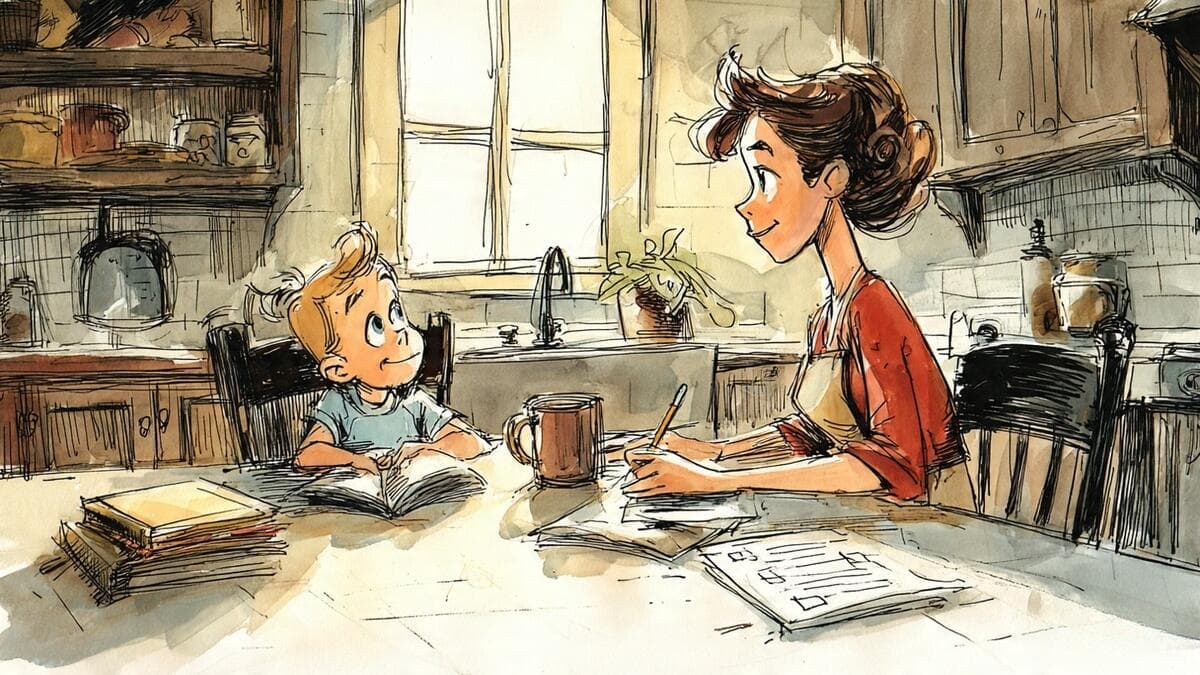
Homeschool planning can go sideways fast when every good intention turns into one more spreadsheet, one more checklist, or one more system nobody wants to maintain.
The good news is that you do not need to choose between chaos and a household run like a compliance office.
In this guide, I will show you how to plan homeschool in a way that gives your days shape, keeps momentum visible, and still leaves room for real life.
Why homeschool planning starts breaking down
A lot of homeschool planning advice quietly assumes that the real problem is not enough control.
So the solution becomes more templates, more categories, more schedules, more color coding, and more admin.
At first that feels responsible.
Then real life hits.
One child flies through a topic and wants more. Another gets stuck. Somebody gets sick. A project takes over the dining room table. A field trip sparks a whole new rabbit trail. The reading you thought would take twenty minutes takes an hour because it turns into an actual conversation.
Now the plan starts slipping.
And once the plan starts slipping, many parents do one of two things:
- abandon planning entirely
- tighten the system until the day feels dead
Neither move works for long.
Here is the deal:
The problem is usually not that you need less structure. The problem is that you need a form of structure that can survive contact with real children and real days.
What good homeschool planning actually does
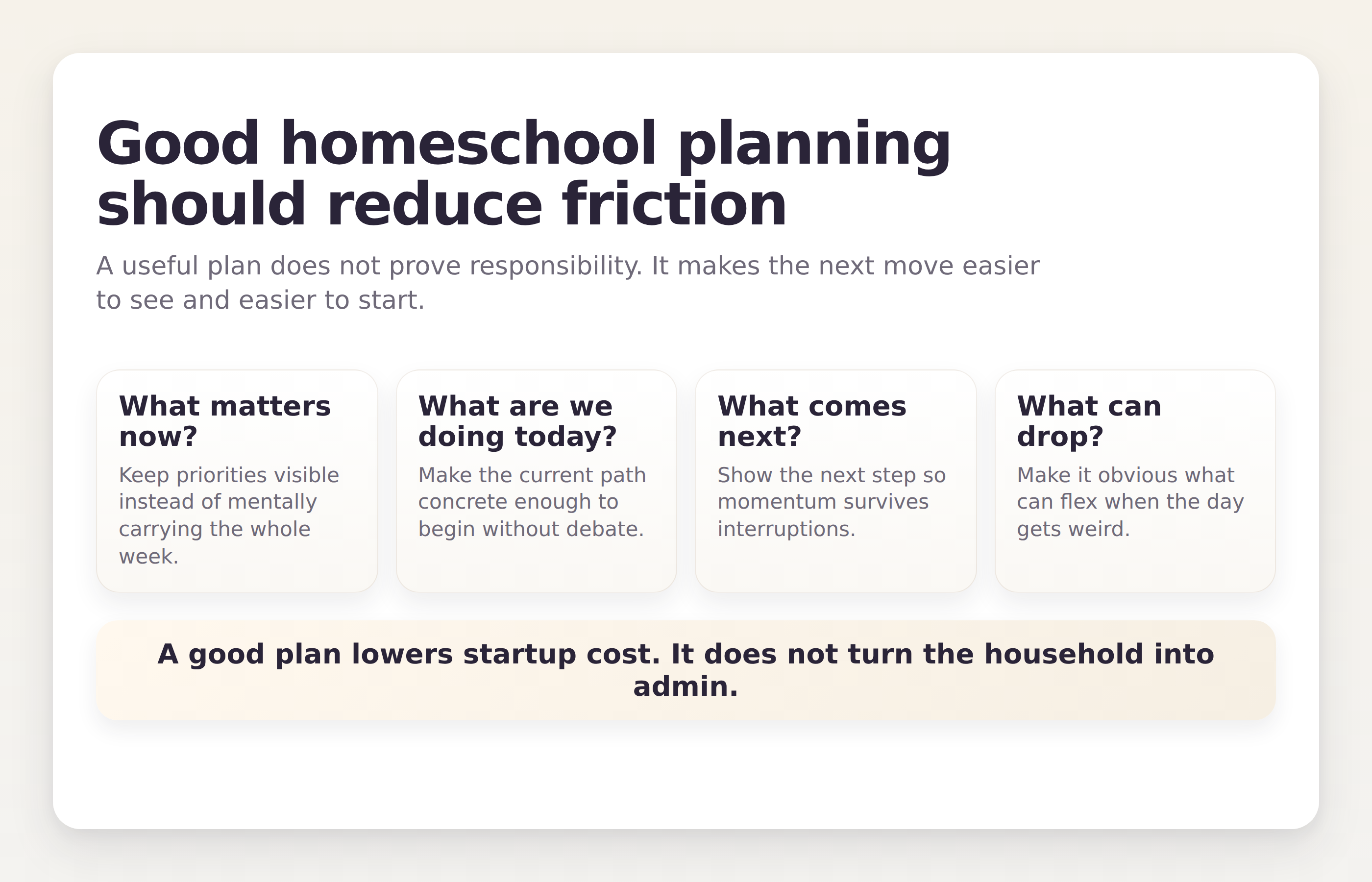
Good planning is supposed to reduce friction.
It should help you answer:
- What matters right now?
- What are we actually doing today?
- What comes next if this goes well?
- What can be dropped if the day goes sideways?
That is it.
A plan does not need to impress anyone. It needs to make the next step easier to see and easier to start.
You might be wondering whether that means keeping everything loose.
No.
Loose is not the same thing as flexible.
A useful homeschool plan still has:
- priorities
- sequence
- visible next actions
- a way to track progress
- permission to adapt
That is enough to keep learning moving without building a miniature school bureaucracy in your kitchen.
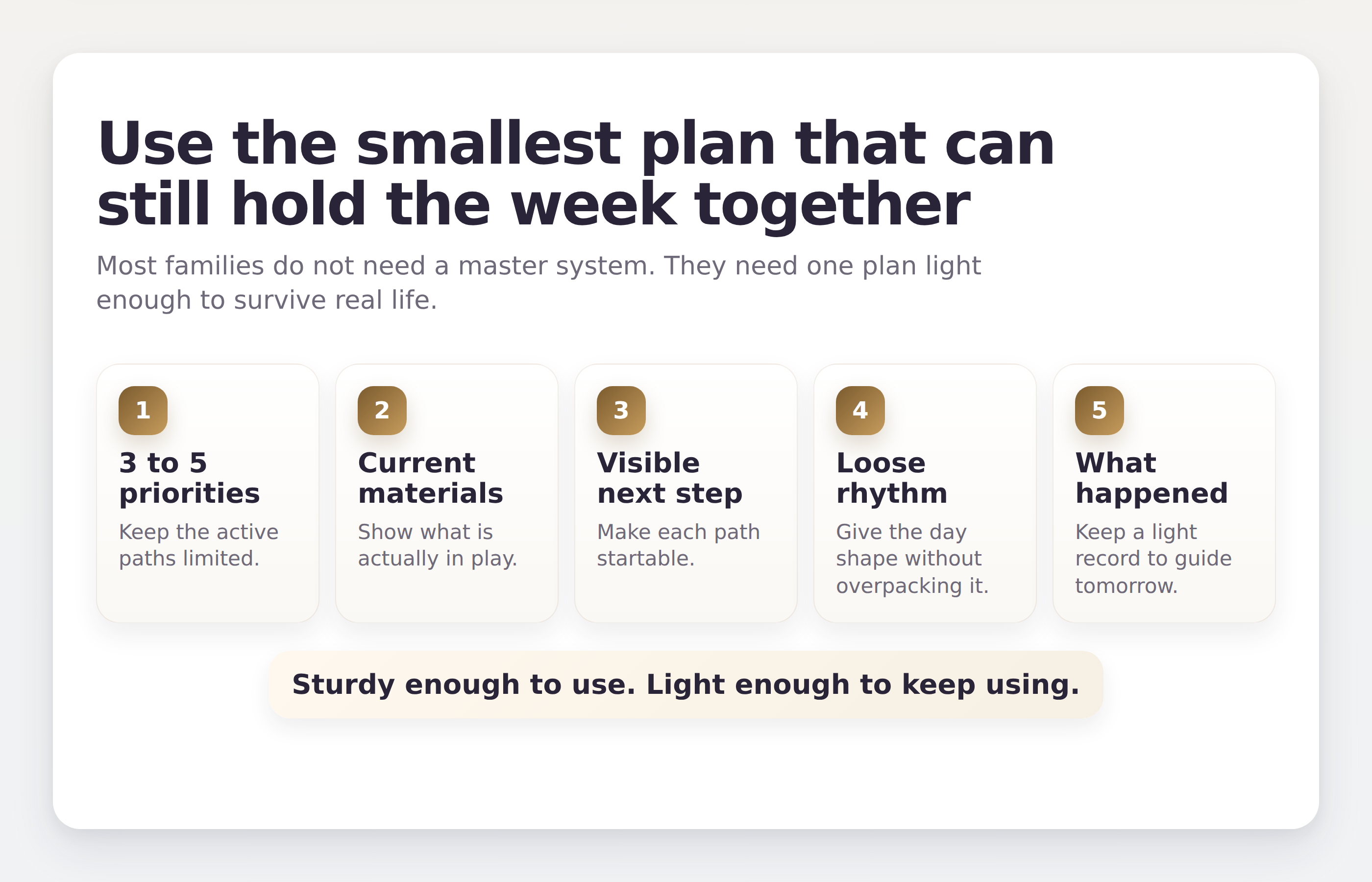
Start with the smallest plan that can hold the week
This is where most people overbuild.
They plan as if the only valid system is one that accounts for every subject, every child, every day, and every possible interruption.
That sounds thorough. It is usually a trap.
A better question is:
What is the smallest plan that can still hold this week together?
For many families, that means:
- 3 to 5 active priorities per child
- a short list of current materials
- one visible next step for each active path
- a loose rhythm for the day
- a place to mark what happened
That gives you something sturdy enough to use, but not so heavy that updating it becomes another job.
Plan around momentum, not fantasy
A lot of planning systems fail because they are built around an imaginary version of family life.
In the imaginary version:
- every child is equally ready at the same time
- transitions are smooth
- energy is stable all day
- nobody resists the hard thing
- nothing unexpected happens
That is not a plan for a real household. That is a performance for a planner.
What works better is planning around momentum.
Look for:
- what starts easily
- what reliably creates engagement
- what needs the most energy and should happen earlier
- what can flex when the day gets weird
- what counts as a meaningful win when everything does not get finished
Want to know the best part?
When your plan works with momentum instead of against it, the whole day needs less force.
Use rhythms instead of overpacked schedules
Rigid hourly schedules look clean on paper. They also break the moment the day becomes human.
For many homeschool families, rhythms work better than hard time blocks.
A rhythm might look like this:
- morning reset and first high-focus task
- reading or discussion block
- movement / snack / outside time
- project or hands-on work
- lighter independent task
- quick wrap-up
That gives the day a recognizable shape without pretending that math always starts at 9:07 and nature journaling always ends at 10:13.
Rhythms are easier to re-enter after interruptions. That matters more than planner perfection.
Keep planning close to the work
One hidden cause of bureaucracy is distance.
The farther your planning system lives from the actual learning, the more likely it is to turn into stale admin.
If your real learning is happening in books, projects, videos, field trips, sketchbooks, conversations, and experiments, your planning system should stay close to that reality.
That means your system should make it easy to capture things like:
- the book you actually started
- the project that took over the afternoon
- the documentary that changed the direction of the week
- the side quest worth keeping
- the next step that became obvious once you saw what clicked
Planning works best when it reflects the living path, not when it demands that the path become standard before it counts.
How to track progress without making tracking the main event
Tracking is where planning often mutates into paperwork.
The fix is simple:
Track what helps decisions. Skip what mainly feeds guilt.
Good tracking usually answers:
- what was worked on
- what got finished
- what is next
- where momentum is building
- where something is stuck
Bad tracking asks you to record everything in five different places so that the record of learning starts taking more energy than the learning itself.
Now:
If a system makes you postpone real work because you first have to update the system, the system is too heavy.
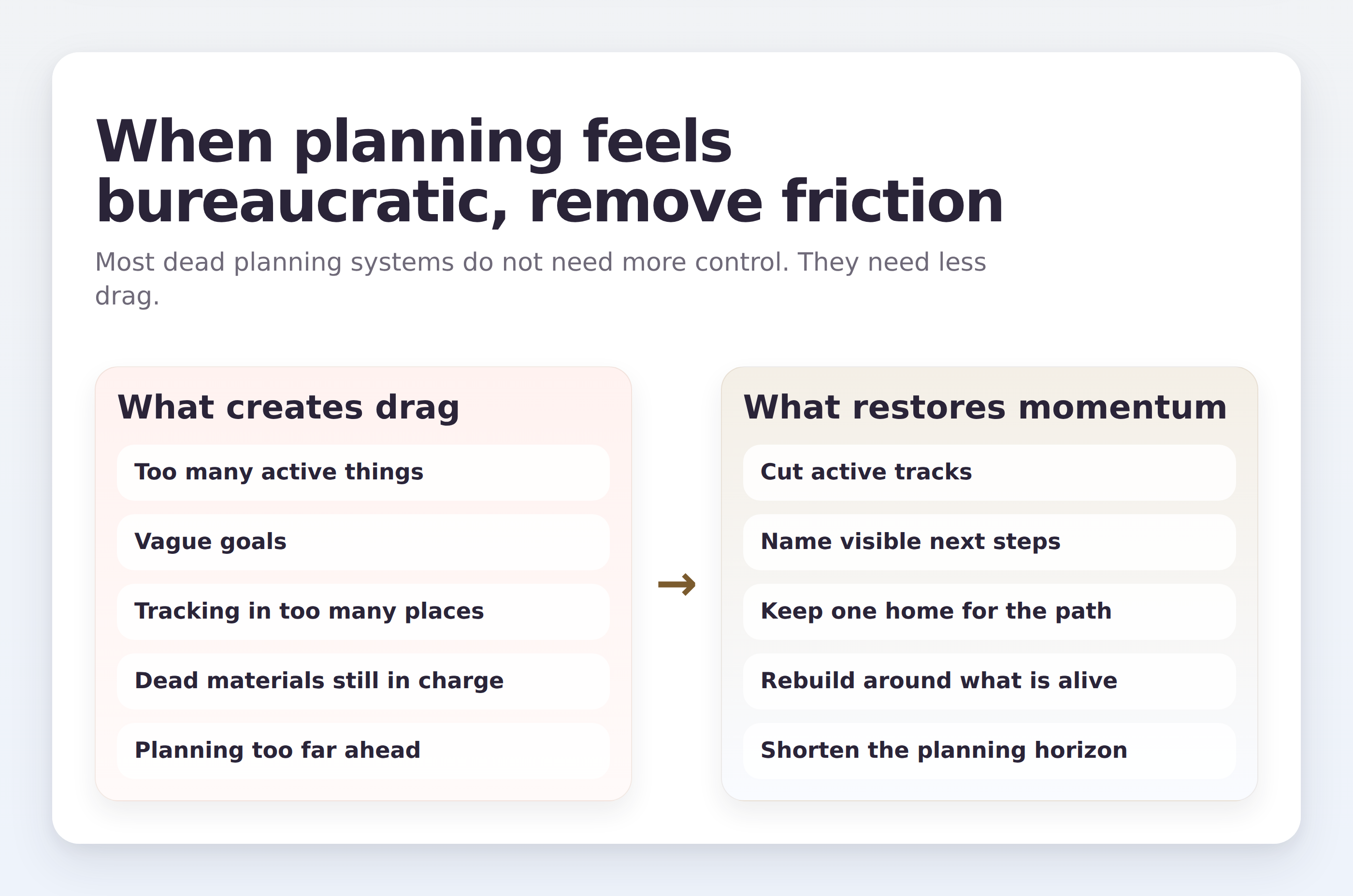
What to do when planning starts feeling bureaucratic
If your homeschool plan starts feeling dead, do not assume the answer is to stop planning.
Usually the answer is to remove friction.
Try this:
1. Cut the number of active things
Too many active tracks create admin drag.
2. Replace vague goals with visible next steps
"Do history" is weak. "Read two pages, mark the map, narrate what changed" is usable.
3. Reduce the number of places you track
One home for the current path is better than a scattered system.
4. Rebuild around what is actually alive
Do not force the week to revolve around materials that are already dead.
5. Keep a shorter planning horizon
You do not need to predict the emotional weather of three weeks from now.
Small fixes like these often rescue a planning system faster than a total overhaul.
A simple homeschool planning method that stays human
If you want a cleaner way to plan, try this:
1. Choose this week's active priorities
Do not plan everything at once. Choose the paths that matter now.
2. Write the next step for each priority
Keep each next step concrete and startable.
3. Decide the rhythm, not the minute-by-minute script
Give the day shape. Do not overchoreograph it.
4. Capture what actually happened
Use the record to inform tomorrow, not to prove you were good.
5. Review and adjust at the end of the week
Keep what created momentum. Drop what created drag.
That is enough for most families.
Why this matters
When planning gets bureaucratic, learning starts to feel like maintenance.
Parents get tired. Kids feel managed instead of invited. The day fills up with control language instead of curiosity.
A good homeschool plan does the opposite.
It helps the household feel oriented. It lowers the startup cost of the next task. It preserves the shape of real learning without flattening it.
That matters.
Because the goal is not to run an efficient paperwork machine. The goal is to make it easier for actual learning to happen again tomorrow.
Final thought
If homeschool planning has started to feel heavier than the learning itself, you do not need more bureaucracy. You need a smaller, clearer, more human system.
Start with the week you are actually living. Choose a few real priorities. Make the next steps visible. Keep the rhythm flexible. Track only what helps you continue.
And if you want a place to hold those paths without turning your house into admin sludge, that is exactly the kind of problem Lesson Hollow is built to solve.