How to Build a Personal Curriculum That Your Kid Actually Wants to Start
Homeschool planning gets messy fast when learning does not fit neatly inside one textbook, one subject, or one pace.
The good news is that you do not need to choose between total chaos and a bureaucratic school-at-home system that makes everyone tired before lunch.
In this guide, I will show you how to build a personal curriculum that feels structured, flexible, and worth starting.
Why a personal curriculum works better for real family learning
A lot of families are already running a personal curriculum.
They just are not calling it that.
You have a stack of books on one subject. A project that suddenly took over the dining room table. A documentary your child watched three times. A field trip that unlocked a new obsession. A math practice habit that works for one kid and absolutely does not work for another.
That is curriculum.
Now, here is the deal:
The problem is usually not that the learning is too weird. The problem is that most planning systems expect the learning to become standard before they can hold it.
That is where parents start losing energy.
You can feel it happen.
You open a planner. You try to force a living learning path into boxes that were designed for a uniform school sequence. Suddenly the thing that felt alive starts feeling administrative.
A personal curriculum fixes that by starting in the right place.
It asks:
- What is this learner actually doing right now?
- What is working?
- What deserves more structure?
- What should stay loose?
What a personal curriculum actually includes
You might be wondering whether a curriculum only counts if it looks formal.
It does not.
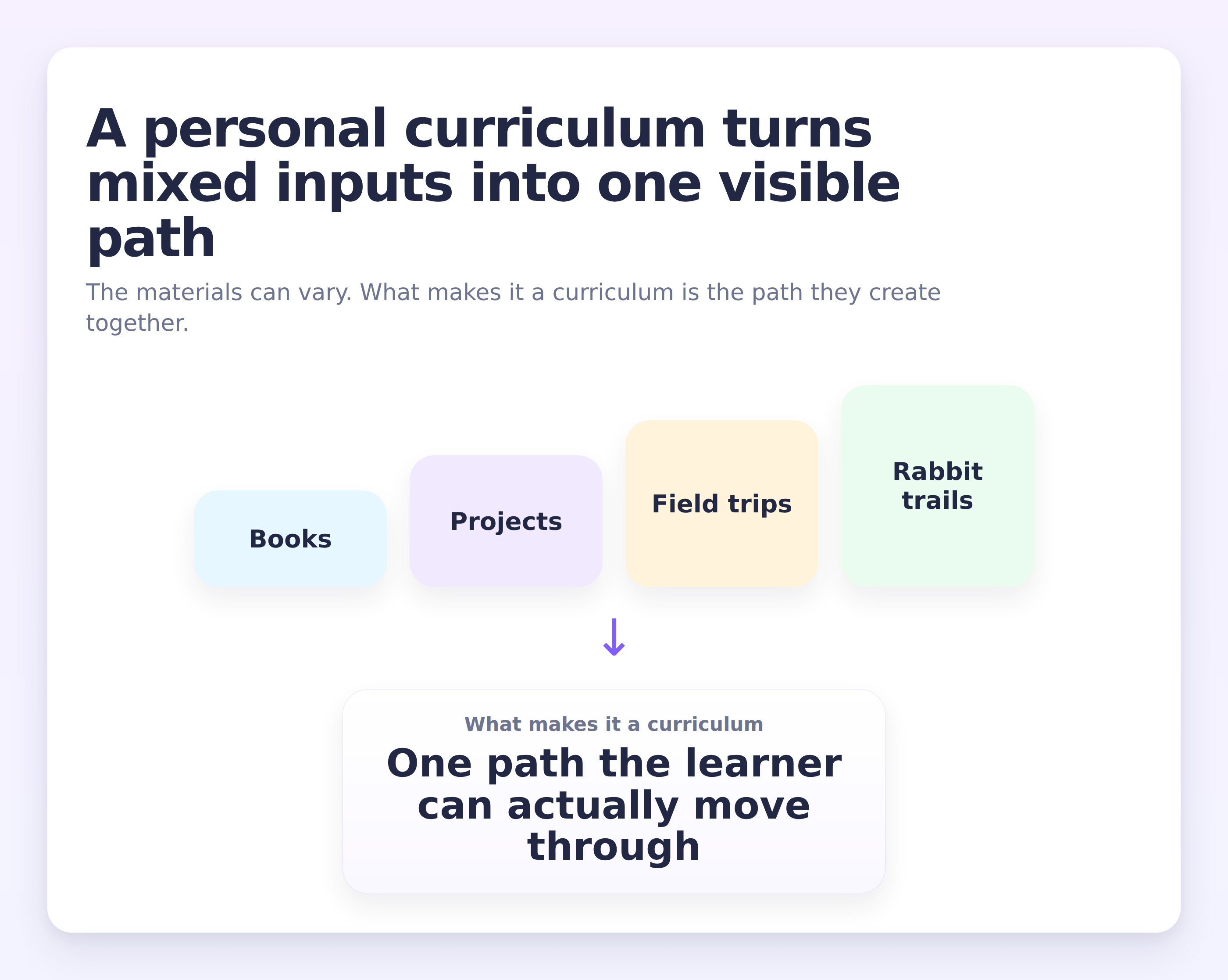
A strong personal curriculum can include:
- books
- audiobooks
- documentaries
- projects
- experiments
- field trips
- hands-on practice
- creative work
- discussions
- skill-building routines
- rabbit trails worth following
What matters is not whether it looks standard.
What matters is whether it creates a path.
Start with what already creates momentum
If you want a curriculum your kid actually wants to start, do not begin with what looks respectable on paper.
Begin with what already creates motion.
Look for:
- the topic they return to without being pushed
- the activity that reliably starts without a fight
- the format that creates energy instead of drag
- the subject where one finished thing leads naturally to the next thing
That does not mean every part of the curriculum has to be fun all the time.
It means the center of gravity should be alive enough to pull the rest of the path forward.
For one learner, that might be kitchen chemistry.
For another, it might be biographies, maps, and sketching.
For another, it might be mixed reality apps on a Meta Quest 3, a documentary project, or a neighborhood nature detective notebook.
Want to know the best part?
When you build around real momentum, you need less force to keep going.
Give the path shape without smothering it
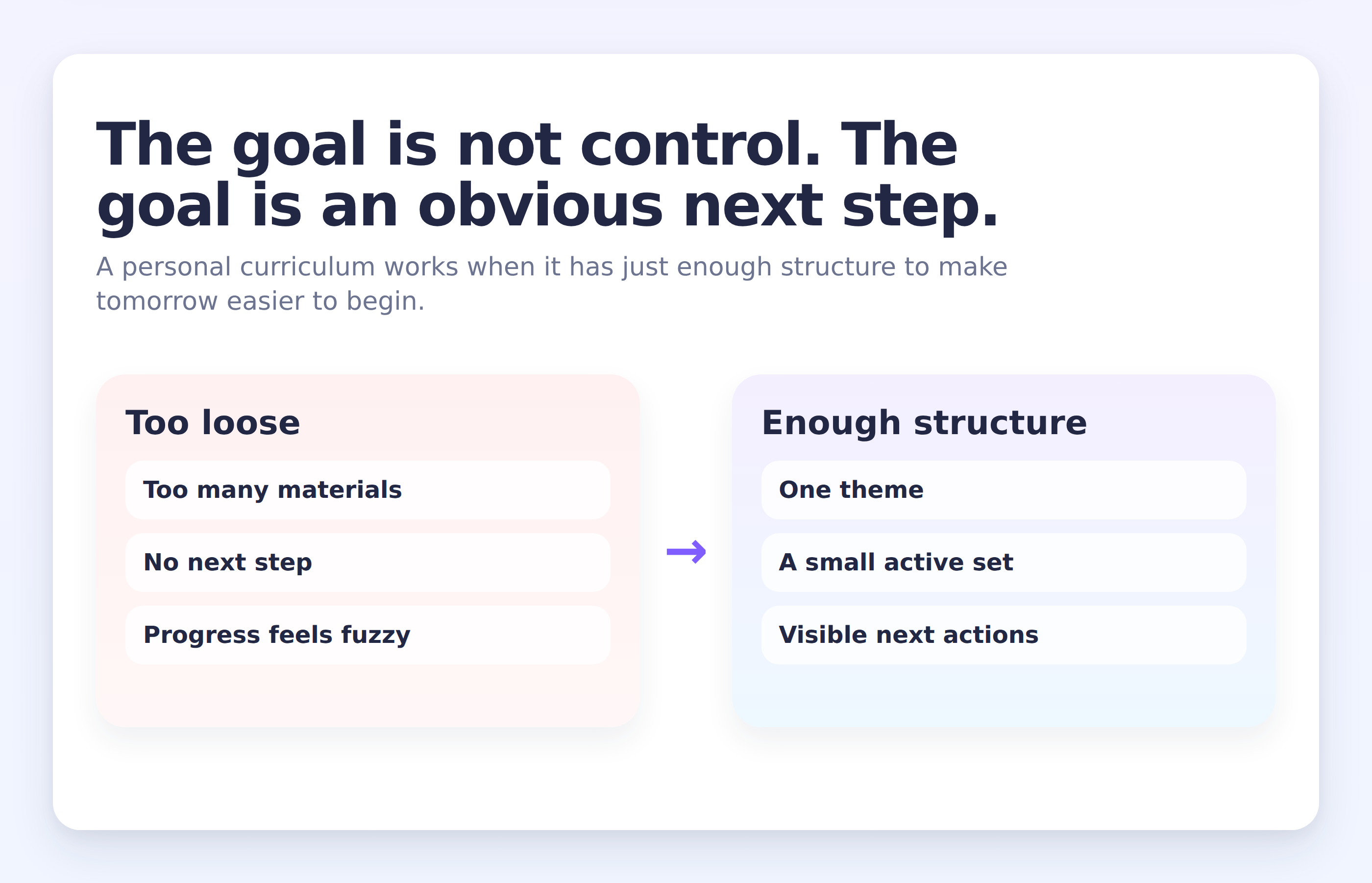
A personal curriculum still needs structure.
Otherwise it turns into a pile of good intentions and half-finished materials.
The goal is not maximum freedom with no shape.
The goal is enough structure to make the next step obvious.
A simple personal curriculum usually needs:
- a clear topic or theme
- a small number of active materials
- a sequence of next actions
- a way to see progress
- room for adjustment when the learner changes
That is usually enough.
You do not need a giant master plan that predicts the next six months in perfect detail.
You need a path that makes tomorrow easier to begin.
Use mixed formats to make learning feel real
One reason personal curriculums work so well is that they let you combine formats that make the topic feel bigger and more real.
For example, a history path might include:
- a biography
- a map activity
- a short documentary clip
- a simple timeline
- a hands-on build or drawing task
A science path might include:
- an experiment
- a notebook page
- a field observation
- a diagram
- a read-aloud or article
A mixed format path is easier to start because it gives the learner more than one doorway in.
Some days they want to read. Some days they want to make. Some days they want to watch, test, compare, or explain.
That variety is not a flaw.
It is one of the reasons the curriculum stays alive.
Track progress in a way that reduces friction
This is where many families accidentally make the path harder.
They build something exciting, then create a tracking system so heavy that nobody wants to use it.
What is the bottom line?
Track enough to preserve momentum and memory. Do not track so much that the tracking becomes the main event.
A good system should make it easy to answer:
- What are we doing?
- What happened today?
- What is next?
- Are we still on a path that feels worth continuing?
That is one reason I built Lesson Hollow.
I wanted a place for personal curriculum that could hold books, projects, field trips, side quests, documentaries, experiments, and all the strange combinations real learning actually takes.
What to do when the curriculum starts going stale
Even a good curriculum can lose energy.
That does not always mean the topic is wrong.
Sometimes it means:
- the next step is unclear
- the format got repetitive
- the pace is off
- the learner needs a visible win
- the path drifted away from what made it compelling in the first place
When that happens, do not immediately throw the whole thing out.
Try these questions first:
- What was the last part that felt alive?
- What format creates the least resistance right now?
- What small win would make tomorrow easier to start?
- What should be cut, paused, or simplified?
This is crazy how often one small adjustment fixes a dragging curriculum.
Sometimes the answer is as simple as replacing a heavy reading block with a documentary and one notebook page. Sometimes it is switching from abstract planning to a concrete sequence of three tasks.
A simple way to build your next personal curriculum
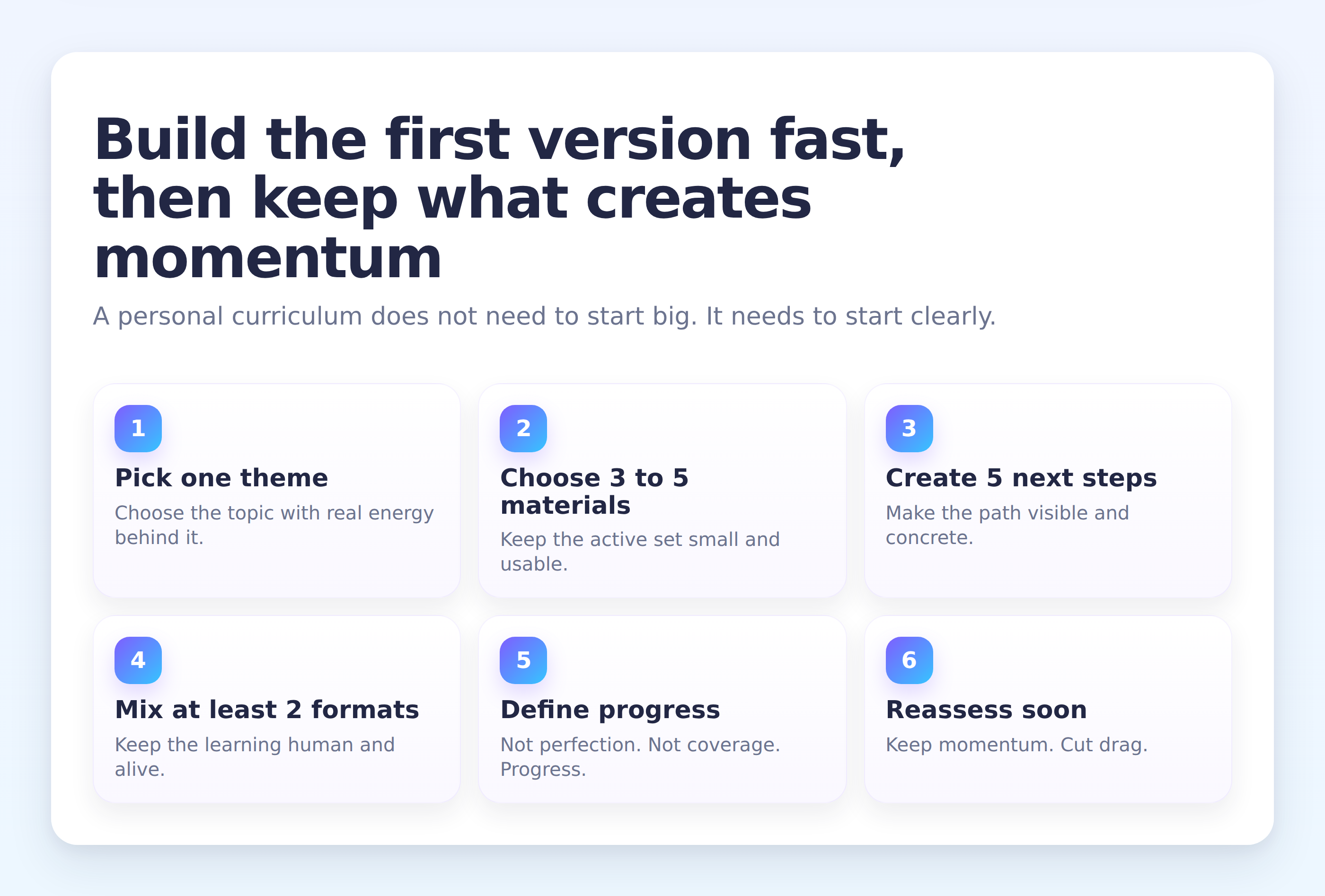
If you want a practical starting method, use this:
1. Pick one clear theme
Choose a topic with real energy behind it.
2. Choose three to five materials or activity types
Do not overbuild. Start small.
3. Create the first five next steps
Make the path visible. Keep the steps concrete.
4. Mix at least two formats
Reading plus projects. Video plus discussion. Field work plus notebooking. Keep it human.
5. Define what progress looks like
Not perfection. Not coverage. Progress.
6. Reassess after a short stretch
Keep what creates momentum. Cut what creates drag.
Why this matters more than people think
A personal curriculum does more than organize learning.
It changes the emotional texture of the day.
Instead of waking up to a vague cloud of things you should probably be doing, you wake up to a path.
A path says:
- here is what matters
- here is what comes next
- here is how this weird, real, interesting life still holds together
That is powerful.
Final thought
If your child resists starting, the answer is not always more discipline, more checklists, or more school-looking structure.
Sometimes the answer is a better path.
A personal curriculum gives you a way to build around energy, curiosity, and real progress without collapsing into chaos.
If you want, start small. Choose one theme, build five next steps, and make tomorrow easier to begin.
And if you want a place to hold that path without flattening it into school bureaucracy, that is exactly what Lesson Hollow is for.