How to Track Multiple Kids on Different Paths
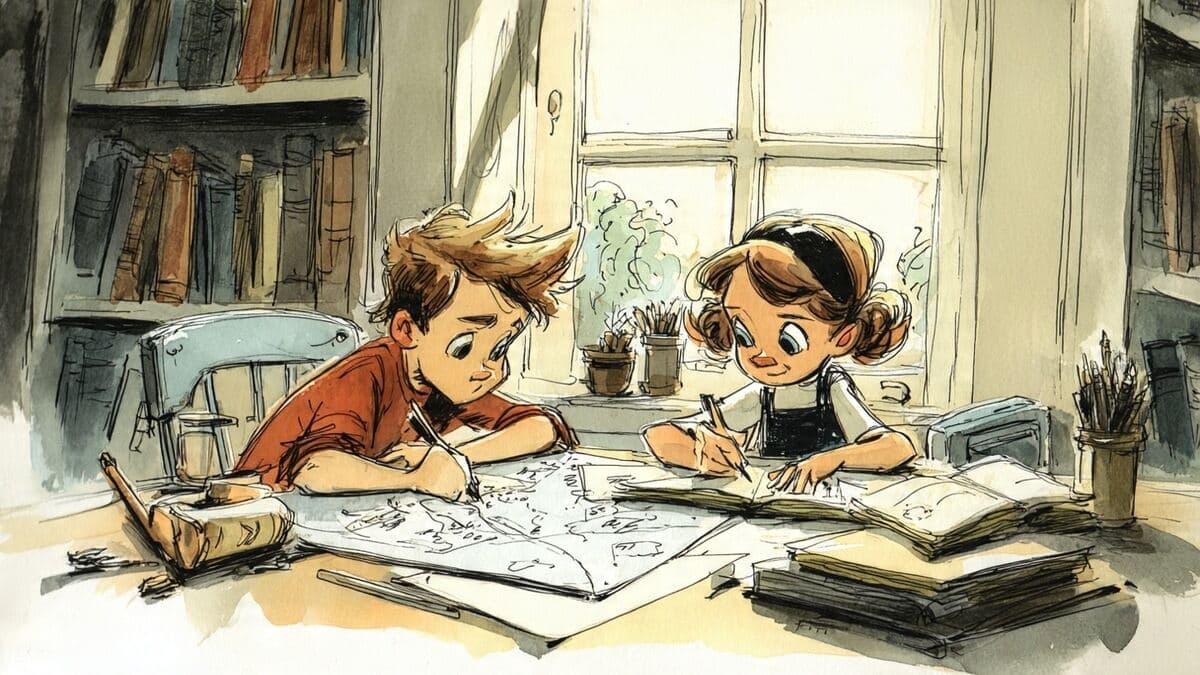
If you are homeschooling more than one kid, you already know the problem gets heavy fast.
One child is deep in a math program that has finally started to click. Another is three books into a Greek myths obsession. A third wants to spend every spare minute building things in Minecraft and asking where lava actually comes from. Somehow you are supposed to keep all of it going, remember where each kid left off, and open tomorrow without rebuilding the whole week from memory.
The good news is that you do not have to choose between that chaos and collapsing everything into one tidy plan.
In this guide, I will show you how to run as many curriculums per kid as actually makes sense, combine purchased programs with custom learning paths you build yourself, and still open each morning with a clear study day for every learner.
What actually counts as a curriculum
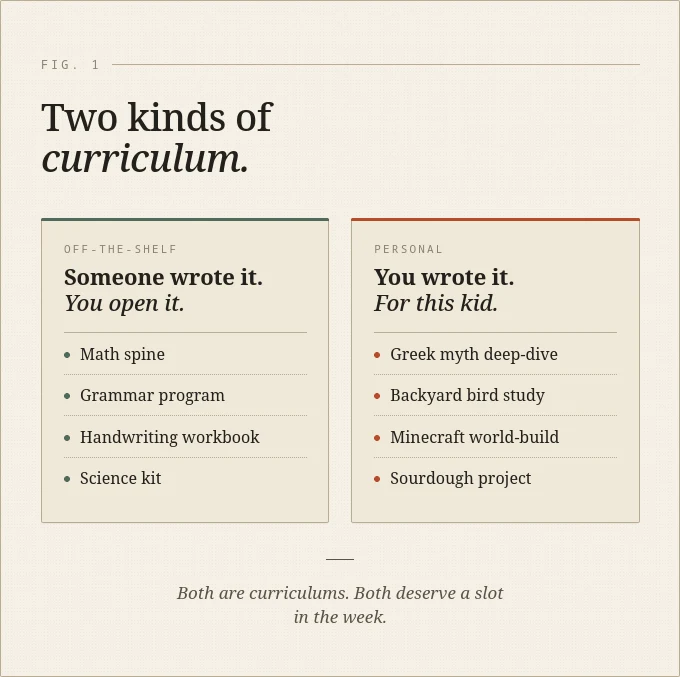
A curriculum does not have to be a boxed program with a glossy cover. In this context, a curriculum is simply any path a learner is walking.
Some curriculums are off-the-shelf. Someone else wrote them, tested them, and sells them as a ready-to-use program. You drop one in and follow the sequence.
Some curriculums are personal. You built them for a specific kid because nothing off-the-shelf quite fit. A reading list you assembled around your eight-year-old's bird obsession is a curriculum. A Minecraft world-building path with weekly goals is a curriculum. A months-long field study of the empty lot down the block is a curriculum. An AR quest path on a Meta Quest is a curriculum.
Both kinds count. Both can be tracked the same way. Both can sit next to each other in the same kid's week.
Once you accept that, the whole idea of running multiple kids on different paths stops feeling like an organizational problem and starts looking like what it actually is, which is curriculum design for a small, real, specific group of kids.
How many curriculums per kid is reasonable?
A lot of homeschool parents quietly suspect they are doing too much. They see their kid's list of active work and flinch. In most cases, they are not actually running too much, even though it feels that way.
Here is the range.
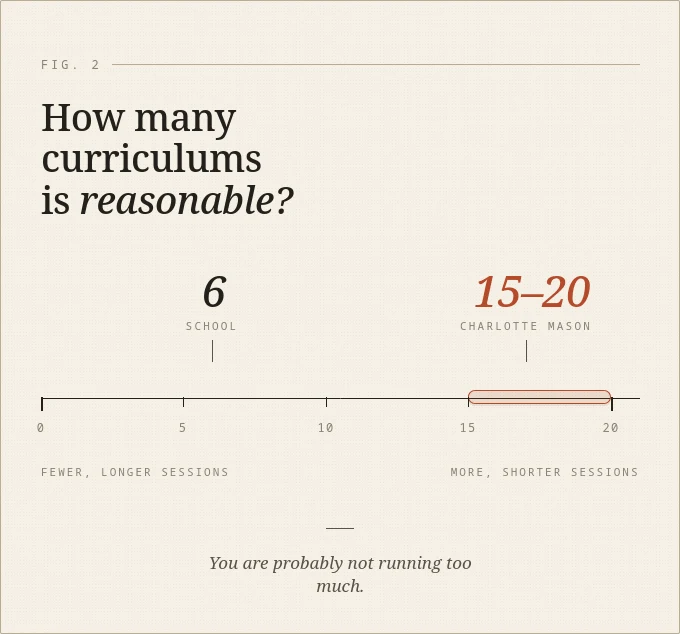
Charlotte Mason families often run 15 to 20 short daily curriculums per kid, because the approach leans on breadth and short focused sessions instead of long subject blocks. Traditional school runs about 6 subject blocks. Most homeschoolers land somewhere in between, depending on ages, temperaments, and what is in season for each kid.
There is no correct number.
The useful question is whether the count you are running is the count you can actually keep in motion without the week fogging up. If the answer is yes, you are not running too much. If the answer is no, the fix is usually to make the curriculums you have more visible, rather than drop any of them, which is the rest of this guide.
Core subjects and interest-driven curriculums belong on the same dashboard
One mental block that keeps homeschool planning heavy is the assumption that "real school stuff" lives in one category and "fun stuff" lives somewhere else. In practice, that split creates double work, because the parent ends up running two separate mental systems for one kid.
A cleaner model is to treat every active learning path as a curriculum, whatever its origin, and keep all of them in the same planning system.
English, Math, and Science are curriculums. The purchased grammar program belongs on the same dashboard as the chosen math spine and the hands-on science kit.
A Greek myths deep-dive, a backyard bird study, an AR quest world, a sourdough-baking project, a woodworking build, and a handwritten history of the neighborhood belong on that same dashboard. These are curriculums too.
Some you bought. Some you designed yourself for a specific kid and a specific season. None of them has to sit inside a tidy subject label to count as real learning. A kid learning history through a video game and a handwritten journal is learning history. A kid learning math through baking, budgeting, and a workbook is learning math. When the school-stuff and the interest-driven stuff share the same dashboard, the whole picture of what each kid is actually doing becomes much easier to see.
The real bottleneck is what lives in your head
A lot of homeschool parents assume that the trouble with tracking multiple kids comes from running too many curriculums. Most of the time the real trouble is somewhere else entirely.
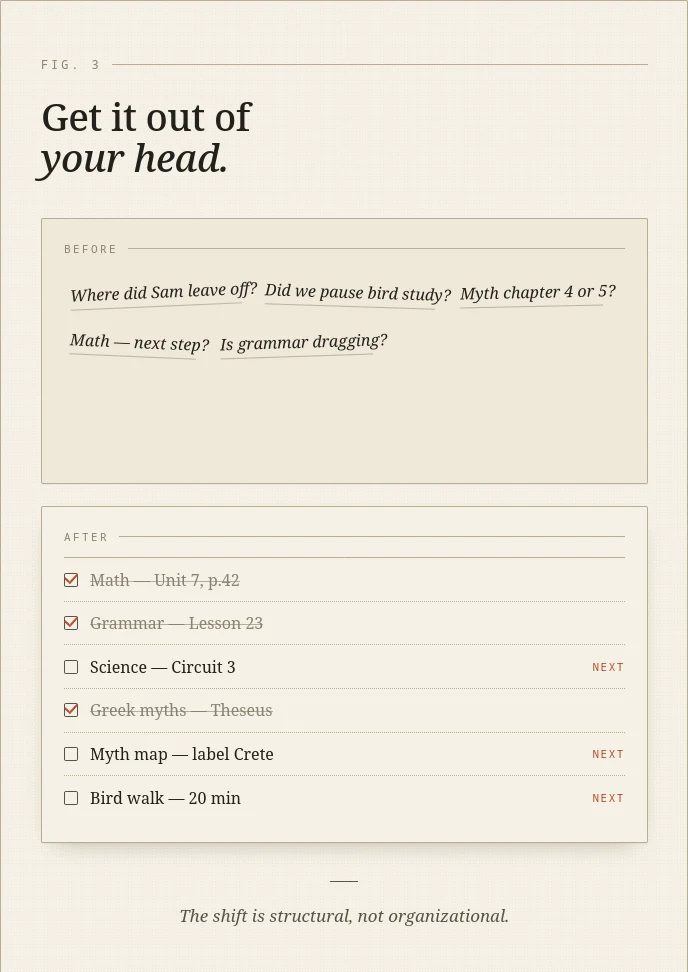
Each kid's active curriculums, their current next steps, and their quietly paused paths all live in the parent's memory, and a human brain can only carry so much at once.
You are trying to hold:
- Which curriculums are active for each kid this week
- Where each one left off yesterday
- What the next step in each curriculum actually is
- Which ones are humming and which are dragging
- Which ones got paused on purpose and which just drifted
That load gets heavier with each additional kid.
When all of that lives only in memory, every morning starts with reconstruction before anything can actually begin. Homeschool parents sometimes call this feeling "homeschool fog." It shows up when your planning system is still your brain, and your brain is now trying to be a planner for three kids at once.
What a visible week actually looks like
The alternative is simpler than most homeschool planning advice makes it sound.
Each kid has their own list of active curriculums. Each curriculum knows its own next step. Each morning, the kid opens a focused study day made of just what is on deck across everything they are enrolled in. The parent sees the picture across every kid without flipping between planners, sticky notes, and tabs.
That is the whole shape.
When the system looks like that:
- The next step is always findable
- The kid can often start work without the parent rebuilding the path
- Pausing a curriculum and coming back later becomes a normal move instead of a lost thread
- Running a lot of curriculums stops feeling out of control
The shift has nothing to do with a prettier planner. The shift is that the picture no longer lives only in the parent's head.
Two real-shaped families
Here is what this can look like for a couple of different families.
Family A: two kids, mixed purchased and personal
The older kid is enrolled in a grammar program, a math program, and a science kit, all purchased. Alongside those, there is a personal curriculum built around Greek myths, with read-alouds, a map project, and a weekly narration.
The younger kid is enrolled in a math program and a handwriting program, both purchased. Alongside those, there is a personal nature-study curriculum built from a field guide, backyard walks, and a sketchbook.
Every day, each kid has a focused study list pulled from their own active curriculums. The parent does not have to invent the day. The system does it.
Family B: three kids, shared math, personal passions
Three kids share a family math curriculum, each enrolled at their own level. Beyond that, each kid has one or two personal curriculums in something they genuinely love. The oldest is knee-deep in a Minecraft world-building curriculum. The middle kid is working through a Lego robotics path. The youngest is keeping a weekly illustrated journal of neighborhood architecture.
There is no forced "family curriculum" beyond math. There is no pressure to push the three kids onto identical paths. And the parent does not end up running three completely separate homeschools in parallel, because the structure is the same for every kid, even though the content is different.
Combine purchased and custom curriculums without switching systems
A lot of parents feel stuck between two camps.
Camp one says: we bought a curriculum, so we should follow it. Camp two says: we want to design our own, but starting from a blank page feels intimidating.
You do not actually have to pick a camp.
A purchased curriculum can sit inside your system as-is. You drop it in, follow the sequence, and track completion along the way. Nothing clever is required.
A personal curriculum can be built from whatever you already have. A list of books. A spreadsheet of activities. A project plan with weekly milestones. A printed reading schedule a friend shared. It does not need to be polished to count as a curriculum, because a personal curriculum is something you are free to refine in flight.
When both kinds of curriculums sit next to each other in one place, the friction of switching systems disappears. Each kid's day pulls from all of it evenly.
The morning habit that keeps every curriculum moving
Once each kid's curriculums are in the system with their tasks sequenced, the day-to-day work becomes much simpler than any weekly planning ritual.
The habit is daily, short, and lives at the very start of the homeschool day.
Each kid opens their list of active curriculums, looks at the next 5 tasks in each one, and picks the ones they can realistically get done today. Those picks land on a single focused dashboard. From there, the kid works through the tasks one by one.
That is the whole habit.
Choosing today's tasks takes only a couple of minutes per kid. The kid scans the next 5 tasks in each active curriculum and picks the handful they can realistically get done today. A lighter day might land at 4 or 5 tasks total. A fuller day might land closer to 10 or 12. Both shapes are fine, because the day's list always comes from curriculums that are already in motion.
If a curriculum is not a fit for today, the kid simply leaves it alone. If a curriculum is not a fit for this season at all, the parent pauses it. There is no ceremony beyond choosing today's tasks, no catch-up drills, and no Sunday-night admin session.
This is how families end up running 10, 15, or even 20 curriculums across their kids without drowning. The sequencing is done once, up front. After that, the daily pick is the only moving part.
What this makes possible
If you pull all of this together, the homeschool you actually want starts to look reachable.
You can run a homeschool that does not force everything into six school subjects. You can run a homeschool where every interest does not have to justify itself to count. You can run a homeschool where you are not carrying the entire curriculum system inside your own head.
That kind of homeschool can hold as many curriculums per kid as genuinely makes sense. It can keep off-the-shelf programs and personal, custom-built paths sitting in one place without competing for attention. It can open each kid's day with a clear, focused study list.
Lesson Hollow is built for exactly this shape. Whether a kid is enrolled in one curriculum or fifteen, whether those curriculums are purchased or handmade, the system holds them together so you do not have to.
If your current homeschool feels manageable only as long as you remember everything yourself, start with one small change. Write down every curriculum each kid is actually running right now, personal and purchased, messy and clean. Put that list somewhere you can see it.
Then notice how much lighter tomorrow morning already feels.